
![[HERO] Stillness Is Not a Setback, It's a Set Up](https://cdn.marblism.com/mG5UwtLwvrA.webp)
You know that feeling when life suddenly gets… quiet?
Not peaceful quiet. Not “I finally have margin in my schedule” quiet. I’m talking about the kind of quiet that makes you wonder if you’ve somehow fallen off track. The kind where everyone else seems to be launching businesses, getting promotions, hitting milestones, and you’re just… here. Sitting in what feels like a holding pattern.
If you’re nodding along right now, I see you. And I need you to hear this: stillness is not a setback. It’s a set up.
The Lie We’ve Been Sold About Productivity
We live in a culture that worships the grind. Hustle culture tells us that if we’re not visibly moving forward, we’re falling behind. Social media feeds us a steady diet of everyone’s highlight reels, making it seem like progress should be loud, public, and constant.
But here’s what nobody talks about: everything powerful you’ve ever made began in a pause.
Think about it. The best ideas don’t arrive in chaos. They rise out of the calm. When you’re constantly running from one thing to the next, you burn through your ideas faster than your soul can regenerate them. You start chasing deadlines instead of vision. You forget why you started in the first place.
Sound familiar?

What Stillness Actually Is (Spoiler: It’s Not Laziness)
Let’s get something straight: stillness is not the same as doing nothing. It’s not scrolling mindlessly through your phone for three hours. It’s not avoiding responsibility or checking out of life.
Stillness is active rest. It’s the space where:
- Ideas are born and visions are refined
- Your nervous system gets to come down from fight-or-flight mode
- Your brain’s creative network (the part responsible for self-reflection and insight) actually gets to do its job
- You remember who you are beyond your to-do list
When you create without rest, your brain doesn’t have time to process. You’re throwing scraps of thought into it all day long, but unless you give it time to decompose and reform, it never grows anything new. You end up recycling the same tired ideas, feeling stuck, and wondering why nothing feels fresh anymore.
That stagnant feeling you hate? It’s often your soul begging for stillness so it can actually regenerate.
The Faith Perspective: God Works in the Quiet
If you’re a person of faith, you’ve probably noticed something: God has a pattern of working in the wilderness, in the waiting, in the stillness.
Moses spent 40 years in the desert before leading the Israelites out of Egypt. Joseph sat in prison before becoming second-in-command of Egypt. Jesus himself retreated to quiet places to pray before major moments in his ministry.
The quiet seasons aren’t punishment. They’re preparation.
When life feels still, it doesn’t mean God has forgotten you or that you’re somehow off His path. Often, it means He’s doing deep work that can only happen when you’re not drowning in noise and distraction.
Psalm 46:10 says, “Be still, and know that I am God.” Not “be busy and prove yourself.” Not “produce your way into my presence.” Just… be still. Know Him. Trust that He’s working even when you can’t see it.

That kind of stillness? It takes more faith than the hustle ever will. To sit in silence and not panic, that’s trust. To create from a place of calm rather than crisis, that’s faith.
Why Your Brain (and Soul) Need This
Here’s the science-meets-spirituality part: your brain literally needs downtime to function properly.
When you’re constantly engaged in tasks, your default mode network (the part of your brain associated with creativity, problem-solving, and self-awareness) doesn’t get activated. This network is like the compost pile of your mind, it takes all the random inputs you’ve been collecting and turns them into something useful. But it only works when you step back from the doing.
Similarly, your nervous system needs regular opportunities to shift from sympathetic (stress response) to parasympathetic (rest and digest) mode. When you’re always “on,” your body thinks it’s in danger, flooding you with cortisol and adrenaline. Over time, this leads to burnout, anxiety, and that awful feeling that you’re running on fumes.
Stillness isn’t just spiritual, it’s biological. Your body was designed with rhythms of work and rest, and ignoring that design has consequences.
What Stillness Looks Like in Real Life
Okay, so you’re convinced stillness matters. But what does it actually look like? Because let’s be honest: most of us don’t know how to just be anymore.
Here are some practical, non-Instagram-perfect ways to embrace stillness:
Start with your breath. Seriously. Five minutes of intentional breathing can reset your entire nervous system. Inhale for four counts, hold for four, exhale for six. Repeat. No apps, no music, just you and your breath.
Put the phone down. Not forever. Just during certain times. First thing in the morning? Last thing at night? During meals? Pick one window where you commit to being screen-free, and notice how much mental space opens up.
Take short prayer pauses. You don’t need a 30-minute quiet time every day (though those are beautiful when they happen). Try scattering 60-second prayer moments throughout your day. In the car before you go into work. While you’re waiting for your coffee to brew. Before bed. Just quick check-ins with God that remind you you’re not navigating this alone.
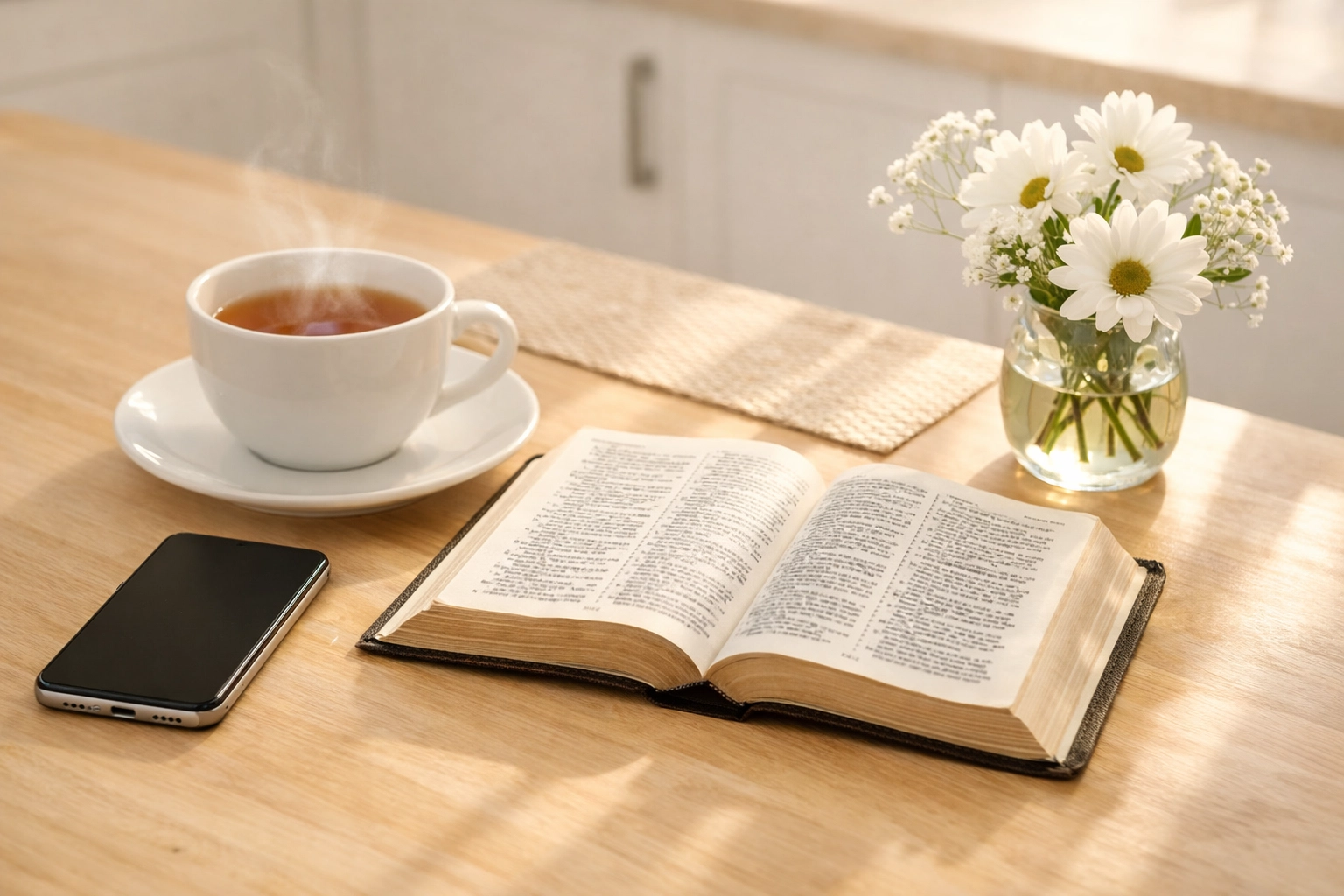
Do one thing slowly. Drink your coffee without multitasking. Take a walk without a podcast. Wash the dishes with full presence. We’ve become so addicted to constant stimulation that doing one thing at a time feels uncomfortable. That discomfort is information: it’s showing you how little practice you have at being present.
Journal without an agenda. Not goal-setting. Not gratitude lists (though those are great). Just stream-of-consciousness writing where you let whatever’s in your head spill onto the page. This is how you find out what you actually think and feel, not what you think you’re supposed to think and feel.
Rest without guilt. This is the big one. Give yourself full permission to rest without needing to earn it or justify it. You don’t have to be productive to be faithful. You don’t have to prove your worth through output. You are loved and valued in the stillness, not just in the striving.
When Stillness Feels Like Too Much
Let’s be real: sometimes stillness feels less like peace and more like sitting with everything you’ve been running from. Anxiety. Disappointment. Grief. Questions you don’t have answers to.
That’s hard. And it’s okay to say that out loud.
If stillness brings up overwhelming emotions or intrusive thoughts, you might need more support than a blog post can provide. There’s zero shame in reaching out to a therapist or counselor: in fact, that’s one of the bravest forms of self-care and faith in action. (If you’re wondering if it’s “Christian” to go to therapy, check out our other post on faith and mental health for more on that.)
But if stillness just feels uncomfortable because it’s unfamiliar? That’s normal. Your soul is stretching. Give it time.
The Set Up Part
Here’s what I’ve learned in my own seasons of stillness: what feels like stagnation is often preparation in disguise.
The ideas that change your life don’t come when you’re frantically trying to force them. They come in the shower, on a walk, in that moment right before you fall asleep when your mind finally relaxes.
The healing you need doesn’t happen on your productivity timeline. It happens in the margins, in the moments you give yourself permission to just exist without an agenda.
The clarity you’re desperate for? It doesn’t emerge from more information or harder striving. It rises out of the calm, when you create enough space to hear the still, small voice of God cutting through all the noise.
Stillness is where breakthrough happens. It’s where you remember your “why.” It’s where God realigns your vision with His. It’s where your soul catches up to your body.
So if you’re in a season that feels slow, quiet, or stagnant: don’t panic. Don’t try to manufacture momentum just to ease the discomfort. Don’t mistake the setup for a setback.
Trust that God is doing something in the stillness. Trust that your soul is regenerating in the pause. Trust that the next season of growth is being prepared right now, in the quiet you’re tempted to rush through.
You don’t have to be busy to be faithful. You just have to be willing to be still long enough to remember who you are and Whose you are.
And that? That’s when the real magic happens.
 In Proces, In Faith
Leave a reply to The Simple Trick to Lower Anxiety Right Now: Why Rhythms Matter More Than Rules – In Proces, In Faith Cancel reply